Monday, March 20, 2017

Bees and Trees


Morgan Glasser
In this week's blog I would like to take a moment and talk about my final project and a little about what we did on the farm. This week on the farm a couple of students set up the irrigation for the apple trees. There was two trees that had already been set up but the four others that we planted last week need to be set up. In order to keep the the irrigation pipe from being punctured we need to dig little trenches to place the pipe in. To keep it safe underground it was surrounded by a pvc pipe. When the pipe was lined up with all the trees and covered we made holes in the pipe to place a drip piece in. Once we finished we tested the water and it worked perfectly.
File_000.jpeg


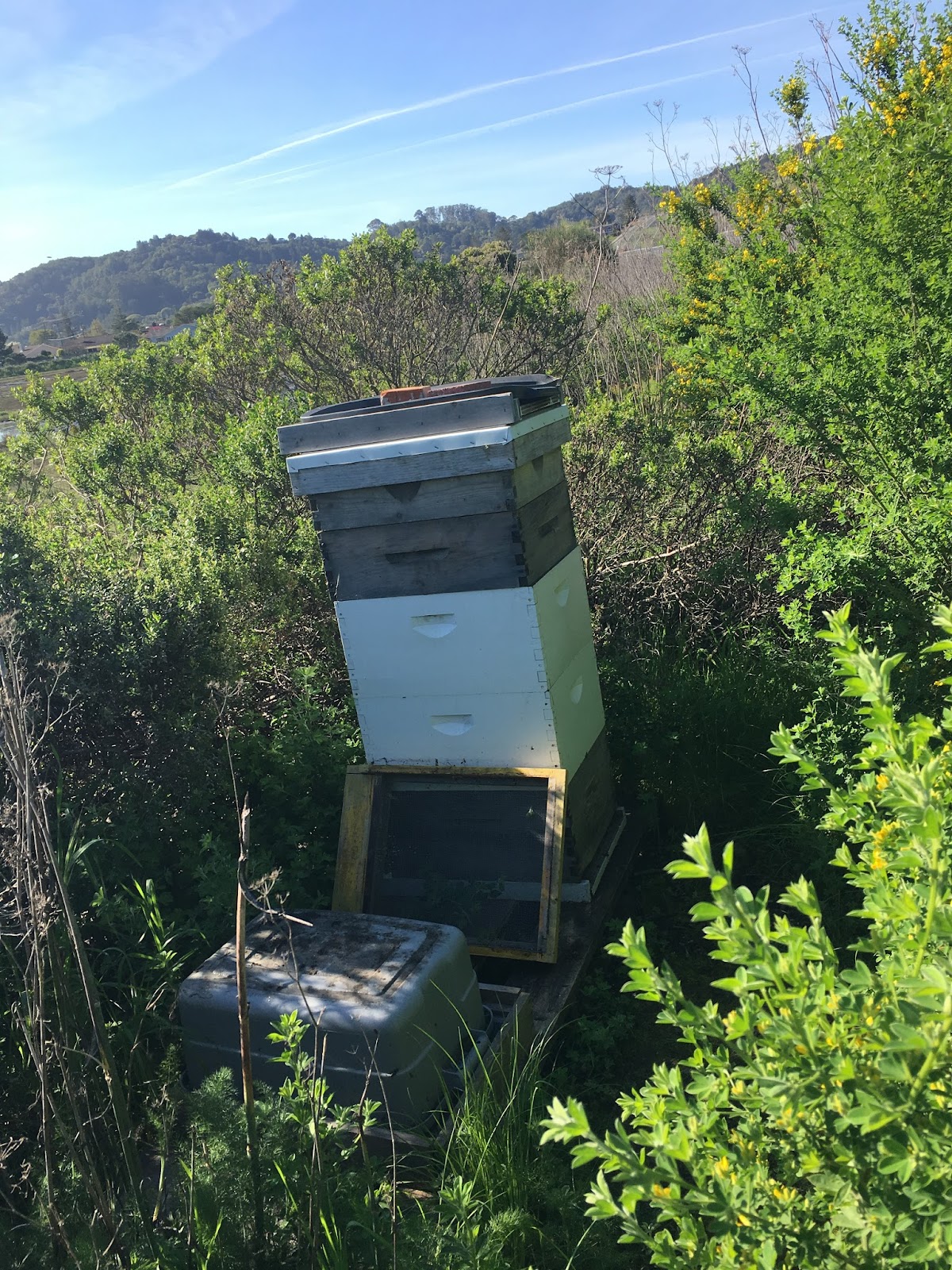
On Wednesday I had a graduated redwood student and current bee keeper come to the farm. The reason for this is because of my final project I would like to have bees on the marsh next to the farm. That day we both went out to inspect the site where the bees are going to go. When we were out there we talked about clearing the area up a little to make it easier to access the bees but still keep them hidden. Another thing we discussed was how many hives should be on the marsh. We both agree that 2 hives is the least we should have for a couple reasons. The first is that if something happens to one of the queens we can just move a queen from one hive to another without have to drive far away to get one. The second is if one hive is struggling we can move more bees to the struggling hive to help it get back on its feet. Another thing that we talked about when it would be a good time to put the bees in, and because of the rain the bee season has been pushed back a little. We need to wait till the rain is stopping and once it gets hotter. Hopefully in about three weeks we can put them in. But before that there is only one hive on the marsh so we need to get another one and make sure we have all the right tools to maintain the hive.
Once everything is in order and checked buy the beekeeper and approved we will have bees on the farm.  


Tuesday, March 14, 2017

Reestablishing Soil!

The sun made quite an appearance this week, allowing us to get to the farm to work and play. Two beds where Mr. Stewart had been growing strawberries for a few seasons needed to be re-fueled and cared for. We did this by applying a method called "sheet-mulching," where we basically cover both beds entirely in cardboard. Then we add a layer of compost and then straw. 

Marin Municipal Water District states, "Sheet mulching is a layered mulch system that nurtures the soil and replaces existing lawns or other vegetation, eliminating the need to remove unwanted plant material." This process is used when a bed is entirely exhausted and weeded over. The process allows for a fresh start and reboots the bed full of nutrients! 

I contributed with picking up additional cardboard at a local bike shop where there are lots of extra bike boxes. 

-Mackenzie Slaugh  

Johns fruit trees


This tuesday we visited the farm at college of marin indian valley campus. They also use the grow biointensive system,  however their farm is very established with a large focus on perennial planting.

 They had one-hundred, fifty of which were olive trees. The rest were various types of fruit.  On average the olives trees produce 300 pounds per tree, which is equivalent to half a gallon of olive oil.

 The group that helped john pruned some of stone fruit trees. We learned winter pruning promotes new growth while pruning in the summer will keep the tree under control. John had us pruning the peach trees, because peach trees only produce fruit on new growth, so every year all the old branches should be cut off as to promote new growth thus making a more productive tree. John told us that most people who own fruit trees are afraid of trimming them because they don't want to hurt them. This makes their trees less productive and over grow.

With a little of work you can make fruit trees that give a larger amount of fruit that is easier to pick because the tree is a manageable shape and size.

Austin 


Friday, March 3, 2017

Cuba

Cuba serves as a model for organic farming. The fall of the Soviet Union resulted in a economic crisis for Cuba because their economy was very dependent on Russia. Cuba lost 80% of its imports as a result, including fertilizers and pesticides. Organic farming methods were introduced to Commercial farmers and organic mini farming (rooftop farming) was encouraged to all Cubans. Land was made available for people to farm for free as long as they were producing food. These solutions solved the food shortage brought about by the fall of the Soviet Union. Today 80% of Cuba's food is farmed organically.

Tommy

RAINS IN THE WINTER SHINES IN THE SPRING


Preston Massey-Blake


This recent period of time on the Redwood sustainable farm has been a preparative moment for Spring. We have planted many seeding trays in advance for the upcoming season. Some of the main vegetables have been cucumbers, squash, leeks, and bell beans. These seedlings will be nice and strong in the next month and will be ready to be planted in our beds. The rain additionally has made the whole garden grow quite a bit and everything is fluorescent green from the broccoli to the grass.

Sustainable Businesses:
A local business that Redwood gets its ice cream from called "Three Twins" is quite the sustainable business. Originally founded in 2005 based out of San Rafael it was founded to be the first mix in the United States of a ice cream company mixing quality ice cream with sustainable practices. They manufacture their ice cream at a factory in Petaluma and get most of their ingredients from organic farms located nearby. This is a more sustainable approach and getting ingredients locally for a product greatly reduces food miles. Food miles are the distance a food or ingredient has to travel from farm to where it is going. By limiting this you are saving fuel and preventing pollution. "Three Twins" does a good job of this and that is why I think they are such a model business. So next time you're at Redwood get some sustainable ice cream from the cafeteria.


Friday, February 17, 2017

​Incorporating Fermentation


Our first iron chef was in the beginning of February. We had our typical assignment, along with the added challenge of incorporating the pickles we  made individually or the kimchi we made as a class. However, the homemade kimchi was not to be trusted and therefore was not included in any of the prepared dishes.
To make the pickles we added hard vegetables such as cucumbers and carrots to glass jars and filled the empty space with water. For every cup of water we added a tablespoon of salt and pickling spices. To make the kimchi we chopped up a variety of greens and compacting them in a container with salt and other spices. Overtime, the bacteria finishes the fermentation process.  
Incorporating the fermented vegetables into the challenge varied from a garnish to a key aspect of the meal. The previous winners entered the hall of fame with their delicious crêpe. Despite the brought in goat cheese and crêpe mix adding a few food miles, the dish was sustainable and therefore worthy of the hall of fame. The pickles were added as a side. The winning dish was a vegetable dish and kale chips. The pickles were incorporated as part of the main dish.

Ella

Rainy week in summary

These last few weeks have been quite unusual in Sustainable Agriculture. Due to the heavy rains we have not been able to be out on the farm very often. This week due to a break in the weather we were able to make it out on the farm on Tuesday. The sun was out and the skies were clear so we took full advantage in order to get some much needed work done. Everyone worked on their management jobs. The compost crew added another layer to the growing compost pile which was started in January. The water crew tested and repaired damage to the irrigation system, which had not been used since last year. The maintenance crew worked on laying down wood chips in the paths, while the companions crew weeded. All groups also took time to work on their one beds, since lots of weeds have sprung up due to the rains. Another important task we were able to complete was planting seedling flats, in order to be fully ready for planting by the time spring comes around. Earlier this week, on Monday, we had a group discussion on the impact of our food choices on agriculture an the environment. By choosing organically and sustainably farmed food, we can helpfully impact the world we live in.
              
  -Kobe