Friday, April 28, 2017

The Time Has Come!


The time has finally come where we are wrapping up the year and using our knowledge and experiences to better the world around us, as well as our garden. 

This week in Sustainable Agriculture we have not been on the farm a lot. We went out on monday and tried Mr.Stewart's new participation grading method where if we were seen working we would receive a star, and needed to earn at least 2 stars to get our participation for the day! This worked very well at keeping everyone on task and not just waiting for when Mr.Stewart is near to get to work. 

This week we also finalized our final projects. On block day we worked on our projects and some of the groups left campus to intern at another farm/organization, like the Indian Valley College of Marin farm picture below. On the IVC farm I got to work in 2 beds removing bermuda grass that had roots over a foot long! As homework for Sustag as well, we read the first 20 pages of our independent reading and creating a reading log, in order to continue to learn about sustainability above what we have learned in class this year and from How to Grow More Vegetables!

-Jonathan Chase

Wednesday, April 12, 2017

Sustainable Redwood

This week on the RHS Sustainable agriculture farm we did a lot of bed preparation in the E beds to accommodate more spring planting. We sheet mulched the beds and paths using cardboard, compost, and straw. Almost half of the E beds are ready for planting. There is also a little TLC being done in the hoop house. This involved laying cardboard and wood chips under the tables, as well as cutting down our beloved bell beans so they could be reestablished into the soil. In the classroom we did an assignment which involved calculating what we would need to make Redwood sustainable. Most of us found that the space required to grow enough food is definitely not out of the realm of possibility. It would require some financial support but it can be done. I think that Sustainable Redwood isn't just an activity. It opened my mind up to a lot of real ways that Redwood can reduce its impact on the environment.

-Max


Last week's journal

This week in SustAg, we were unfortunately unable to spend as much time as we usually do on the farm because of rain and our mid term! However, spring is an important time on the farm and we worked very hard last week planting seedlings and transplants so that we will have producing crops soon. The soil is saturated with water and the sun hopefully is warming up our beds, making for ideal planting and growing conditions (http://www.ufseeds.com/). While the weather wasn't awesome this past week, we kept busy and working off the farm by discussing ways to improve our current farm.

In the "Sustainable Redwood Design" activity, we explored how sustainable the Redwood SustAg Farm would be if we fed all Redwood students lunch every school day (which we can!). Additionally, we brainstormed improvements and ways to make the farm better than it already is. For example, to conserve water, we can use dry soil tillage and create a rain water saving device. Dry soil tillage utilizes water from past seasons during an especially dry one by protecting the surface, and growing plants adapted to drought. To expand the Farm without using more on-campus land, we could experiment with living roofs or vertical gardens. These would increase the area in which we grow without having to expand our farm limits. There are many other ways we can improve our farm but for now we are focused on a successful spring season and are looking forward to when we can harvest next!

Audrey

BIRB: Beneficial Insect Reservoir Bed

For my final project, I am creating two beneficial insect reservoir beds with beds C9 and C10. A BIRB is a bed that contains crops specifically planted to attract beneficial insects to the farm. Beneficial insects are companions that promote production on the farm in a number of ways. These insects are very helpful for dealing with pollination and fighting pest populations. 

In order to obtain the plants I need for my project, I needed to reach out to local organic nurseries to see if they were able and willing to help me. I sent an email introducing myself, the farm, my project, and sent a list of potential crops that I am looking for. This list included:

Purple poppy mallow
Cinquefoils
Sea lavender
Evening primrose
California Milkweed

Most of the nurseries replied in a very helpful manner and I ultimately decided to go to Green Jeans Garden Care in Mill Valley. At Green Jeans, I was able to find four starters for crops that I thought would be a good idea to plant in my bed. I bought a mallow plant, a salvia plant, and was donated two seedlings of california milkweed. I chose these plants because of their high nectar contents and because they were highly recommended by the Green Jeans staff. 

After finishing the weeding and sheet mulching in the two beds, the next step is to transplant my newly obtained crops. After this step, my project will be nearly complete.

—Al

Saturday, April 1, 2017

This Week

This was a busy week for Redwood's Sust Ag class. We spent this week accomplishing things that needed to be done. We were also blessed with great weather that allowed us to work on the farm. 

On Monday we all worked in class on our Sustainable Redwood project. Unlike most other projects done in other science classes, this one really made us reflect on how we can realistically make Redwood High School a more sustainable school. To do this we all worked with our bed groups to calculate how much farming space we would need to feed the entire population here. We used results from past harvests to get a sense of just how much space we would need to achieve this. After coming to an answer the next step was to see where this space would come from and how Redwood would operate with a larger farm. For my group specifically, we decided that the Football field and JV Baseball field were redundant as we already have field space for both those sports, so we would have hypothetically turned it into farmable land. We also made sure to include a water tank so we could have our own source to be more off the grid. Collectively, the entire class all thought of ways Redwood can be better with the hopes that some of these ideas may even come true.

On Tuesday, we were able to manage some time out on the farm which was nice. With the collected cardboard we covered 4 of the E beds, and after school, that day was spent sheet-mulching the E beds. On block day we did a lot of work on the E beds. We planted lettuce in the newly made beds and continued preparing them for more planting. Overall, we got a lot of work done this week. 

-Tiago Schwartz

Wednesday, March 22, 2017

Spring planting has finally arrived!

By Maia Mazur


This week on the Redwood SustAg farm, we have begun our spring planting. We began this process by weeding the desired area in our bed to plant, and placing some very awful smelling fertilizer on top. In my personal bed, weeding was the most strenuous task. There were so many species of weeds that had taken over the majority of our bed, most of which were deep rooted and difficult to remove. I found that the sickle was the most efficient tool to remove the weeds the in the shortest amount of time.

To top it off, we placed about an inch of compost to provide vital nutrients to boost root growth for the seedling transplant. An important part of seeding transplant is to find, and use the proper spacing to allow enough room for the plant to grow to its full potential. Some of the groups failed to do this, and were asked to re-space, and re-plant. Spacing your plants is important because if it is not done, the plant is more susceptible to nutrient deprivation, mildewing, and lack of sunlight.  Some of the seedlings that we were able to plant in our beds were squash, broccoli, lettuce, and other greens.

Besides the progress that we were able to make in our individual beds, we were able to plant some strawberry seedlings into the C beds. The C beds had been previously sheet mulched, so the soil became very fertile for strawberry growth.


Monday, March 20, 2017

Bees and Trees


Morgan Glasser
In this week's blog I would like to take a moment and talk about my final project and a little about what we did on the farm. This week on the farm a couple of students set up the irrigation for the apple trees. There was two trees that had already been set up but the four others that we planted last week need to be set up. In order to keep the the irrigation pipe from being punctured we need to dig little trenches to place the pipe in. To keep it safe underground it was surrounded by a pvc pipe. When the pipe was lined up with all the trees and covered we made holes in the pipe to place a drip piece in. Once we finished we tested the water and it worked perfectly.
File_000.jpeg


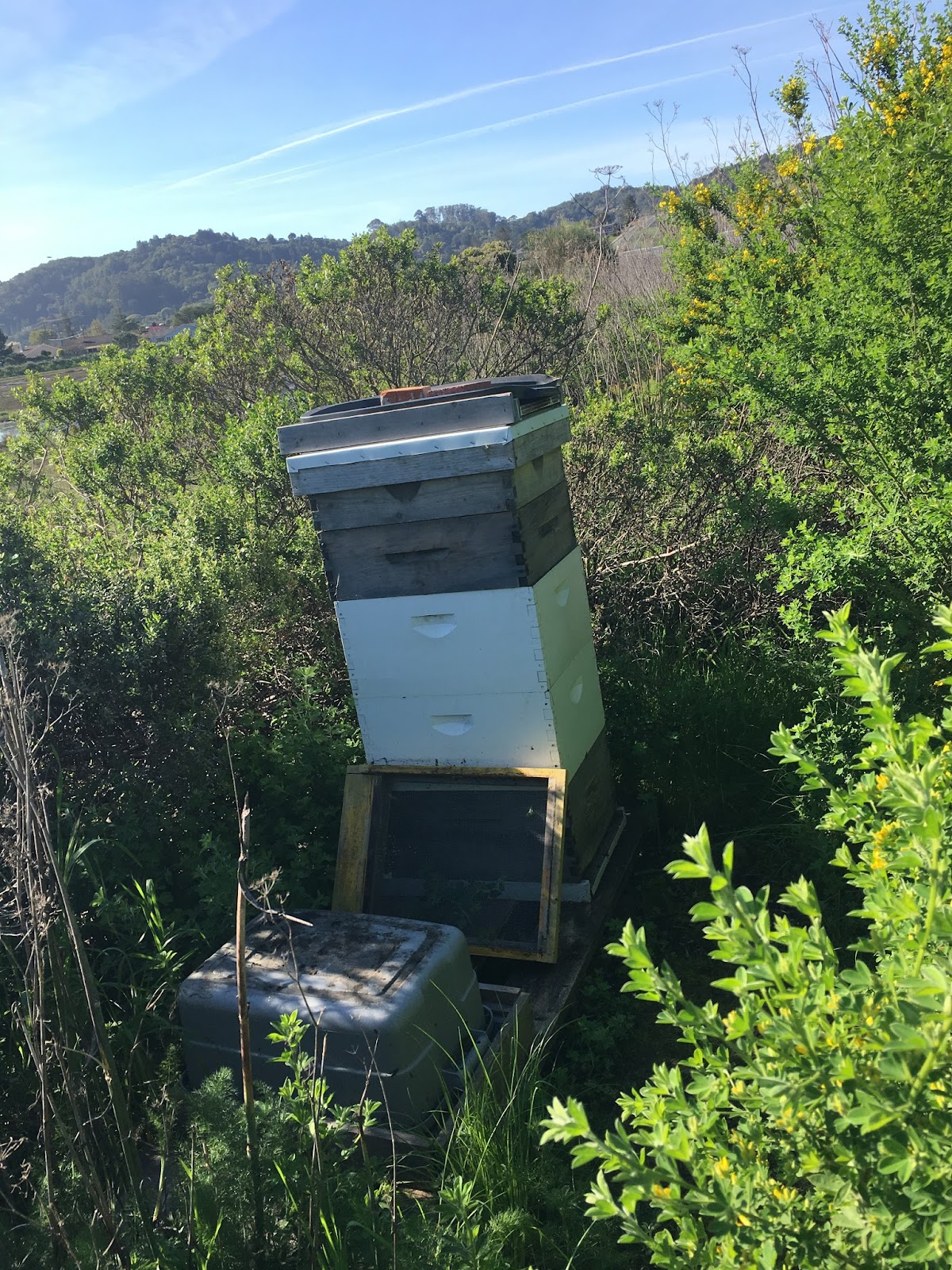
On Wednesday I had a graduated redwood student and current bee keeper come to the farm. The reason for this is because of my final project I would like to have bees on the marsh next to the farm. That day we both went out to inspect the site where the bees are going to go. When we were out there we talked about clearing the area up a little to make it easier to access the bees but still keep them hidden. Another thing we discussed was how many hives should be on the marsh. We both agree that 2 hives is the least we should have for a couple reasons. The first is that if something happens to one of the queens we can just move a queen from one hive to another without have to drive far away to get one. The second is if one hive is struggling we can move more bees to the struggling hive to help it get back on its feet. Another thing that we talked about when it would be a good time to put the bees in, and because of the rain the bee season has been pushed back a little. We need to wait till the rain is stopping and once it gets hotter. Hopefully in about three weeks we can put them in. But before that there is only one hive on the marsh so we need to get another one and make sure we have all the right tools to maintain the hive.
Once everything is in order and checked buy the beekeeper and approved we will have bees on the farm.