Tuesday, November 6, 2018

Farmer's Market Visit


This week in sustainable agriculture we took a small field trip to the Marin Farmers market, located at the Town Center Mall. At the venue there were a variety of different market stands with assortments or different food. We also had the honor and pleasure of speaking with the co-founder of the Marin farmers market, Lynn. She talked to use about all the nuances that go into having a successful farmers market. In this particular picture, it shows a picture of a market stand by Rodriguez Farms. They primarily grow, pick and sell strawberries. When we asked them about their picking process they explained to us that they have close to 60 pickers at the farm and only have two genders at the market. This allows them to increase profits by having more people at the farm picking to get more strawberries on a daily basis. We also talked to many other market stands and when we came in contact with J and J Ramos farms we learned about their way of extracting bugs. They use a machine that goes over all of the plants and is a vacuum. It sucks all the bugs into the vacuum, extracting them away from the plants where they could eat and eventually lower the overall yield. This also plays a large role in the environmental impacts this has. Instead of using pesticides, which are proven to be very harmful to the environment, they use the vacuum which is much more sustainable on a farm setting.          - Zack Gordon


Saturday, November 3, 2018

Socratic Seminar


This week in class, we put our knowledge to the test through doing a socratic seminar! We prepped for three separate discussion questions overviewing topics we have learned thus far in the semester. Each of us got assigned to one question to discuss in front of the class, backing our point thoughtfully with data. The first discussion question covered the topic of sustainability when it comes to agriculture, specifically planting techniques and how they affect environment, economic and social realms. Many students brought forth techniques we use on the farm, as well as suggestions to further our yields and planting advancements. The second question expressed the concerns of soil erosion and soil fertility. Students shared how to address these problems with specific examples, such as planting more grass/shrubs to hold soil together to prevent erosion and protect soil with leaves. The third and final question we discussed focused on water usage and conservation. Individuals proposed conservation techniques not only to participate in on the farm, like drip irrigation and hand watering as shown in picture, but also at home, and how these viewpoints should change during a drought. Overall, our first socratic seminar was in many ways a success! —Sophia C


November Market Day


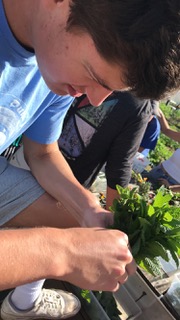
As a great week came to end end, Market Day approached. In preparation, the class worked extra hard to maximize the weeks yield on the farm. Day by day, the class utilized many methods to adequately prepare the soil for the harvest. As each bed group layered on compost, watered if needed, and planted what they could, the farm was thriving. On Friday, the harvesting began. From strawberries to beats, the class collected as much as it could. Students such as Dean Watson (top left) made a tenacious effort to precisely bundle the crops, and as the sixth period class (top middle) worked through the period, the Market Day was nearing. With time, the buckets filled up until the day was coming to an end. By sixth period, the crops were ready to be sold. As Scott (top right) and other students filed through, the crops began to sell, and by the end of the day, the class reached a whopping $205.


Marsh v Farm


This week the Sustainable Agriculture class studied beyond the Redwood farm. As student farmers, we spend almost all of our time either learning directly on the farm itself or learning about the farm in our classroom. We have grown accustomed to our own one beds and the different species around us, but what about the different types of ecosystems that we haven't been exposed to yet? Mr. Stewart introduced us to the marshland that is just a short walk away from the Redwood farm. We spent around 10 minutes observing different types of species that occupied the marshland, such as Salt Wart plants and Mud Hens. There were many different animals and plants that we've never seen before. We then went back to our more familiar farmland and observed the different species that we have been working with for the whole semester. We compared what we saw on the marshland to what we saw on the RHS farm. There were some things that we saw in both ecosystems such as bees and Fennel plants but there were more differences than there were similarities. We then asked ourselves how we could have the RHS farm mimic nature more. Although many species would have a difficult time adapting to a new ecosystem, we concluded that one way to make the Redwood Farm mimic nature more would be to add an aquatic aspect somewhere on the farm. It may be difficult but over time we can slowly add new things to the farm to make it more diverse and include different species from different ecosystems! -Nina

Voles are Friends Not Food!


The Redwood Sustainable Agriculture farm is proud to host habitats for many beneficial companions; however, some--like the vole--are not necessarily desirable. During multiple visits to the farm, students have spotted these pesky critters burrowing through the beds and marking their territories with their feces. Just recently, a student was startled when one scattered across the shed floor. After further investigation, we found it had sneakily chewed its way through the floor!

Voles are often mistaken for the moles, shrews, and mice because of their short brown fur, dark eyes, and hidden ears. Other names for them are meadow mice, ground moles, field mice, and meadow moles. The most common method of recognizing a vole invasion is by inspecting your beds. These miniature rascals create above ground "runways" to store food and reproduce in. They will often cluster in areas where overhead vegetation is present. As you can imagine, this creates problems for planting: they spread disease through their urine and feces and introduce parasites. Although they won't typically feed on farm crops, their digging will disrupt roots and soil nutrients, ultimately inhibiting growth. If populations are small, one might attempt to trap them in order to avoid damage. But if populations are large, pest control might be necessary.

PS. The vole was too quick to snap a photo, so I included one off the internet. —Olivia C


More new crops

During the week in sustainable agriculture Mr Stewart told us that we were going to be having a "pop quiz". Whenever I hear the words pop quiz I think oh no, but this time it wasn't all that bad, it was also the  start to our class beds. All the groups had to double dig ⅓ of a bed using or knowledge from what we read in the textbook. After all the double digging and the fertilizer was added we planted our crops. In my group we decided to plant broccoli, beets, fava beans, garlic, potatoes, lettuce, sweet peas and latter on we added some arugula. I learned that it is essential to water your plants for a couple weeks right after you plant them. And also to make sure the roots are buried almost all the way to the first leaf. I also learned that not all of the crops we planted would make it, they might have wilted or got eaten by pesticides.  
      Image result for double digging garden at redwood high schoolImage result for the steps of double digging
—Kate B.


Friday, October 19, 2018

Soil


In our new unit in Sustag, we are focusing on fertilizer and how to sustainable care for the soil in our one bed gardens. Last week, one of our homework assignments was to complete a reading log on a chapter about fertilizer. A fertilizer is a material of natural or synthetic origin that is applied to soils to supply plant nutrients essential to the growth of plants. Many sources of fertilizer exist, both natural and industrially produced. In the reading, we read about different sources of nutrients and soil modifiers such as phosphorus and potassium and how their addition to the soil can add important nutrients to the soil and supply them to the surrounding plants. When we planted our one beds in the beginning of the year, we added fertilizer to the top of our bed to help improve the structure of the soil and increase the ability of the soil to hold water. The book reading also talked about how to sustainably add compost and fertilizers and in order to do this use most of the food that is grown at home and "grow" your own fertilizer. Going forward, we will continue to use organic fertilizer in our one bed as an amendment and addition to the cycling of nutrients. —Scott