Monday, October 30, 2017

The Farm's Impacts on Mental Health


     A few months into sustainable agriculture and I have noticed that everyday after class I am always feeling happy and refreshed. So, I thought it would be interesting to see if this was true for the rest of the class. How does working on the farm impact our mental health?
     Personally for me, the farm helps me relieve my stress during the school day. After sitting in classrooms all day worrying about tests and grades, it's great to take a break and be outside to focus on taking care of the farm and our beds. Simple acts such as planting seedlings or weeding my bed make me feel so much calmer. Grace Willens, a sustainable agriculture student, agrees that the farm helps her de-stress, "being out on the farm helps me relax in between classes." Zoe Stakowski appreciates how the farm offers a hands on learning environment, outside of the classroom, "The farm gives our minds a break from the stress of school, even though we are still learning!" Sam Jackson further proves my notions  by stating, "I love being outside for a period everyday. It is a nice regeneration time and is fun to work on something that you can see improve over time."
Scientific research also reinforces my notion. "Gardening shows us that we are but a small part of nature, and getting over such feelings of insularity and self-­absorption is an automatic antidepressant," says Malati Jagasia, a child psychologist based in Mumbai.
Overall, I think it's clear that being on the farm is quite beneficial both so our education and our mental health.
So with that, thank you Sustainable Agriculture!
 - Ines S


Glow up


The RHS farm has undergone some changes the are making the farm really glow-up. This past week we did quite the revamp of two beds that had not been touched since last year and we cleaned up the some of the surrounding area of the farm. With this being our first full week in a while, we had more time than we were used to in order to perform this glow-up. The class put some work into our new maintenance jobs (water, compost, maintenance, and companions.) Each having their own special set of responsibilities on the farm. My group is companions this time around and we were quite busy clearing out the weeds on the outside border of the farm as well those surrounding the few precious grape vines we have. 
    To add to the glow-up of the farm we revamped two forgotten beds adjacent to each other. These were wasted space which can't be afforded on such a small farm. So Mr. Stewart assessed us on how well we could bring them back to life. We had to weed the beds meticulously and continued to use a U-bar to aerate the soil. Next, we used an 8-inch dibble board to determine where each lettuce seedling would be planted. When planting we had to be very careful to allow the roots to be fully extended once in the ground to ensure good results from them. 
At the end of the week we had two new beds on their way to success and some good lookin' grape vines!


Sam Jackson :)


Last Week


This week block day was very busy with painting signs for the browns and sticks piles in the garden, as well as the lid for the amendments bin. Due to the composting area being moved across the farm to next to the hoop house a few weeks back, the farm was in need of some new signs to make the farm easier to navigate, and the signs will also be easy to spot for newcomers to the farm, and for those of us used to the old layout of the farm.

Other students also started to plant seedlings into 6-section carriers, and worked on building up the compost pile. Lauren and I picked up the compost from the CEA, who were happy with our arrival to take the compost out to the farm. Our beds also needed some maintenance with some weeding as well as adding some nutrients to the soil as a result of the soil tests that we finished a week ago.

On Monday and Tuesday, we worked on a lot of review for the upcoming midterm and seminar on Monday and Tuesday of next week, as well as going over the compost reading log that we finished for Tuesday's class.

Micaela W.


Dana on the Farm


Dana N. on the Farm
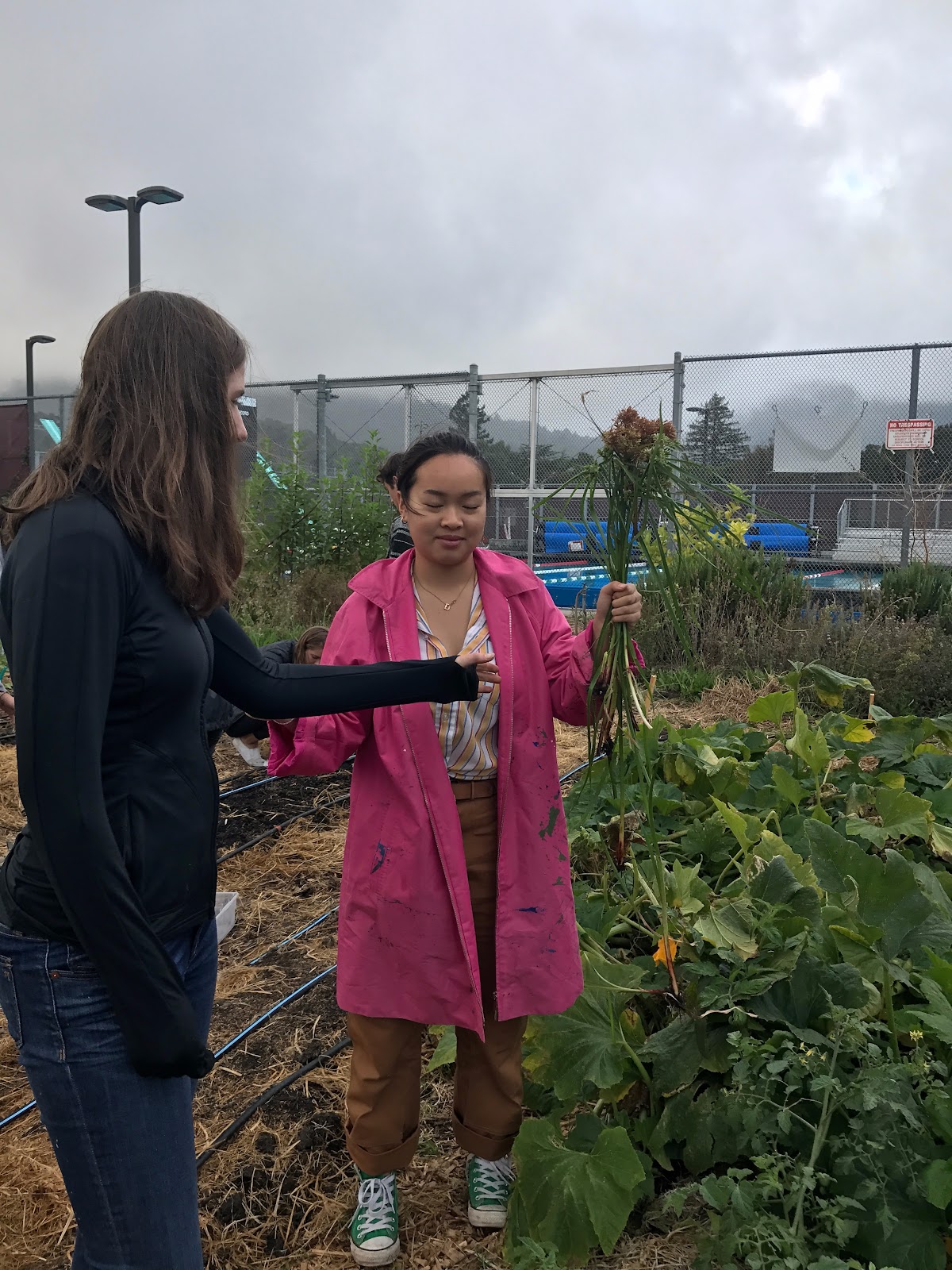
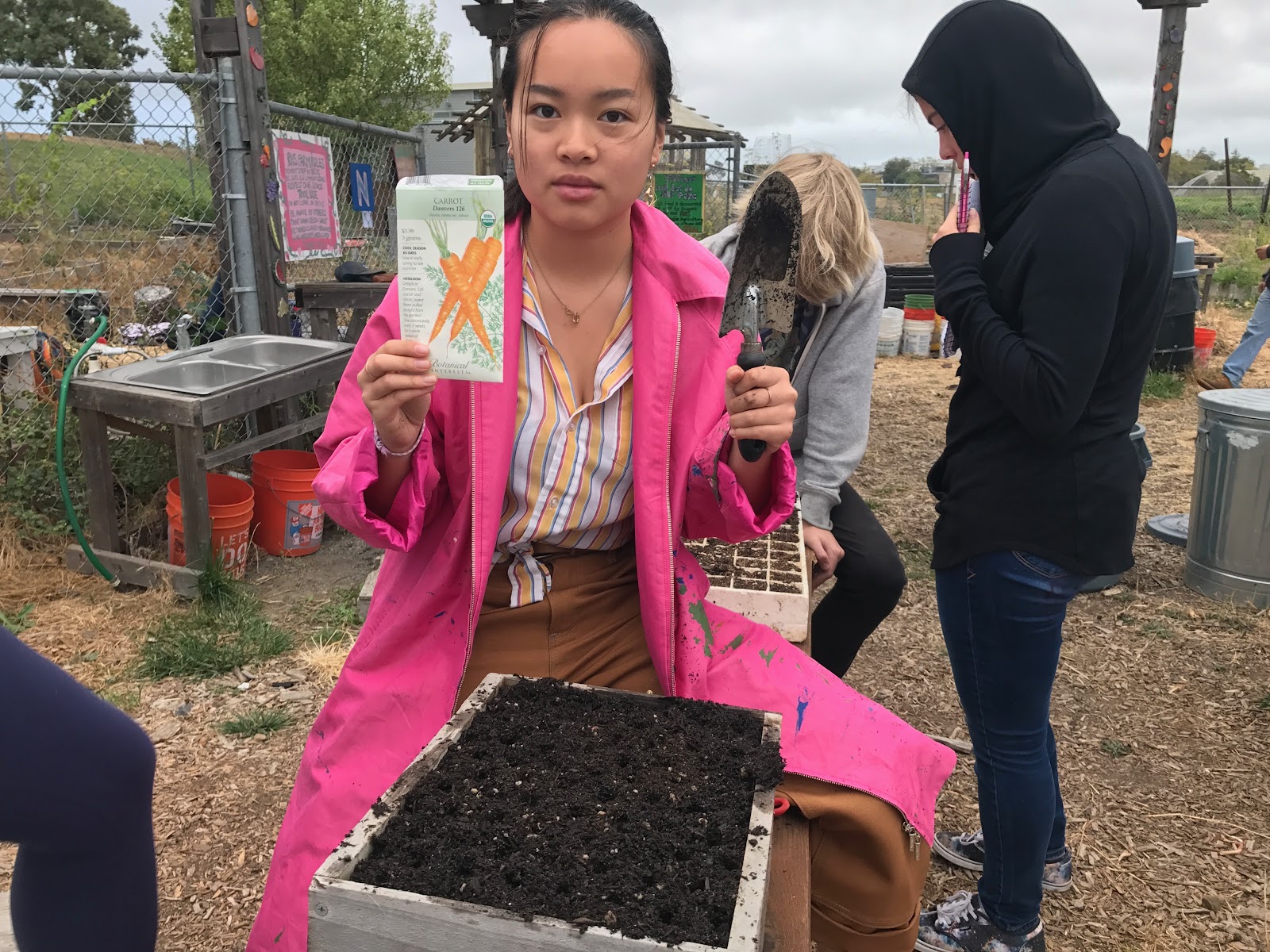
Just like other students in the fourth-period Sustainable agriculture, Dana is a really hard worker. Whenever she steps into the gates she is in her farm clothes, overalls, and closed toe shoes, and she is ready to work. "I'm always prepared and excited to start a new day in the garden." She helps the farm by weeding,
Watering,
Planting,
And harvesting.
Dana got her love for being in the garden after spending time at Oxbow Boarding School's garden of inspiration. She has taken that love into caring for our redwood farm. She is especially good at weeding, which comes in handy with her group's bed because it seems to always have weeds that need to be taken out. Dana also loves to use foods from the farm in her own kitchen, once recipe that she is particularly proud of is for baked squash. Dana is looking forward to spending the rest of her senior year continuing to do more hard work on the farm.

Anna Kaufman

Thursday, October 26, 2017

A Great Week on the Farm

We have a seminar and midterm coming up so we focused on doing that in class on Monday and Tuesday. In the farm this week we got to add amendments to our beds. Last week we did squeeze, shake, and chemical tests using soil from our beds to determine how many lbs of amendment we had to add. After doing these tests and calculations, we determined that we had to add about 1.5-2 lbs of amendment. We used Phyto Grow which has Nitrogen, Phosphorous and Potassium in it. I am really excited to see how this affects our plants and if they grow any stronger and faster than they were before. My one bed had a huge tomato plant in it and we decided to take it out today so that cleared up a ton of space in our bed. We also harvested a really nice rutabaga from our bed! Mr. Stewart really wanted us to use up all the bell bean seeds so we planted a lot of those in the space we had after taking out the tomato plant. Bell beans are about ½ inch thick so we planted them a ½ deep into the ground because you are supposed to plant seeds as deep as they are thick. I am in the watering group, so after planting the bell beans I watered a couple trees that border the farm and watered my bed a lot. It has been super hot lately so we are going to have to make sure our newly planted bell beans get enough water. It was a pretty great week in sust ag!

Grace Willens


Friday, October 20, 2017

New Bed


This week students focused on clearing space for a new RHS farm bed. This new bed was to come from the space previously taken by the compost piles. The current compost piles were moved to the back of the farm, against the northern facing side of the hoop house.h With the relocation of all but the September compost pile to deeper within the farm will allow for approximately 300 new square feet of previously not used planting area. With this move came the reminder that the farm was placed over an old parking lot. This became apparent when students started hitting large chunks of concrete approximately 8 inches into the soil. This fact can be negated with the use of double digging, extra soil, and compost. This will be achieved by double digging the older dirt and placing newer fertilized soil on top to form a convex (bulge) in the bed. This will allow for more depth for plants roots to grow and a less harsh mixture compared to the old dirt that has been compacted from people walking on top for years. This will be a class project over the next few weeks. With the smoke clearing it is looking to be full steam ahead with these new developments.

Kaelin Stock (I'm sorry for the lack of photos)

Thursday, October 19, 2017

First Full Week in A While

This week in Sustainable Agriculture we finished our soil reports, and worked on class beds. On Monday and Tuesday we worked on the soil tests. We finished the shake test, feel test, and chemical tests, and later analyzed the data. My group found that our soil was silty clay loam and had a pH of 6.6. The class data had an average mean pH of 7.2, which was higher than the recommended 6.7pH. We wrote a narrative and summary about our soil test, and handed the assignment in on Wednesday.

On Wednesday block, we worked on class beds and planted transplanted crops. My groups' bed was covered in weeds, so we were assigned an alternate bed named C2. It was covered with a tarp so my group had to roll it up. Under the tarp was a vol, which Luke Zlatunich caught! However it escaped his hands, jumped on another student, and escaped. After this exciting event, we removed the dead grass that had died from being trapped under the tarp. Then, we aerated the soil using a spading fork, and covered the bed with a layer of compost. After, we watered the bed thoroughly, and then began to plant the celery. We used a six inch dibble board for spacing, and planted approximately half the bed with celery. We used a spoon and knife to get the celery and its roots out. We were very careful in not hurting the roots while placing them in the holes. After planting the celery, we watered the bed again to help the celery grow. We had a little time to work on our management jobs after. It was a very productive and educational week in the classroom and on the farm.

Victoria van Pruissen