Monday, May 13, 2019

Worm Composting


From addressing the issue of flooding, to creating a pumpkin patch, sustainable agriculture kids are in the process of developing their final projects.

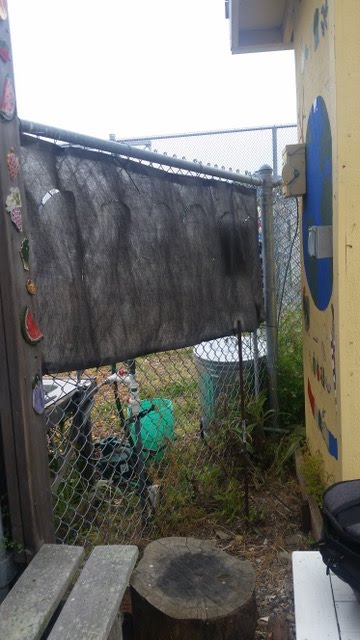
For my final project, I am working with Alex to establish a worm compost system onto our farm. As of the moment, we have found a used worm composting tower, have allocated a space on the farm for the tower, and have begun setting the space up to accommodate the worms. Over the summer, the worms will need a space where they can stay cool and hydrated, so we have set up shade netting in the "worm spot" to protect them from the heat and we will rigging extended irrigation to their tower that is synced to the crops' irrigation schedule. We have also asked around for worms but are also going to use worms from our own beds and around the farm in the mix. And finally, we will need to create and install a sign to remind people of the worms and help them locate the tower as well.

Hopefully, through the establishment of this worm compost system, we will be able to produce more compost and at a faster rate to help close the loop on our farm. (Image: our worm spot with shade netting)

- Sarah

Socratic Seminar


This week in class, we put our knowledge to the test through doing a socratic seminar! We prepped for three separate discussion questions overviewing topics we have learned thus far in the semester, but with a twist. Each of us chose a book to read and log throughout the month, to ultimately write a report on. We each applied our new knowledge we gained from our books and applied it to our socratic questions to discuss in front of the class in the circle, backing our point thoughtfully with data and statistics from our readings. The first discussion question covered the topic of themes in society, economics, and the environment that are interlocked through sustainability, where we shared ideas from our books on how to promote these themes. The second question expressed the concerns of unsustainable practices. Students shared how to address these problems with specific examples of solutions,, and prioritizing what would be a good method for immediate action.  These included such things as installing insulation is a way to combat CO2 emissions sustainably, and other practices that every individual can do, due to not everyone having access to a farm like ours. The third and final question we discussed focused on the future. Students proposed their examples from their books that demonstrated a sustainable future for agricultural systems. Our class agreed that a community based system is easier, and more productive than doing so single handedly. Teamwork makes the dream work! Overall, this socratic seminar was a success, it was interesting to see all the different sustainable approaches each author took, whether it was a sustainable lifestyle, or farming, there were many ideas we could apply to our own lives and class farm! —Sophia


CEA and SustAg

The weather has gotten warmer over the past month, causing increased plant growth and blooming of flowers. Many transplants have been planted, including tomatoes and beans that will contribute to our future market days as the good weather continues. Lettuce and chard transplants in beds A15 and A16 are doing especially well; their growth is a result of their biointensive spacing that places them closer together to discourage growth of weeds. Some of this lettuce and chard was sold to the CEA this week along with some kale from the D beds. This shows progress towards school sustainability because locally-grown greens are now being implemented in the CEA's meals. Making a greater effort to connect CEA food to Redwood's Sustainable Agriculture farm would reduce Redwood's carbon footprint if we further implement this in the future. —Alex

Monday, May 6, 2019

Final Projects Have Begun!

We've dived straight into the first week of May with our final projects for Mr. Stewart's class. Wednesday, 5/1, was our first official, full class Project Work Day.

My group, consisting of myself and two other girls, is building new slots for compost piles. We've brought in wooden pallets and laid them out by the hoop house, to mimic the current slots the farm already has. The sifter by the entrance in the hoop house has been moved back to the chicken coop, where another group is conducting their project. These pallets are roughly the same size as the ones previously brought in, so the goal is to make all of the slots a similar or identical size.

These final projects inspire creativity and promote taking initiative, making them a fun challenge! It will be exciting to see how they will transform the farm.

Final Projects


         This second semester of sustainable agriculture has been focusing on why we do various things a specific way such as sustainable farming techniques: intensive plant spacing, using certified organic inputs, etc… While we have learned about why we grow organically and use specific inputs on the farm, we have observed how we could improve the farm even more. We have also been influenced with ideas from guest speakers, a number of documentaries, and Mr. Stewart to determine a final project that can benefit the community as a whole or specifically the sustag farm.
         For my final project I have chosen to address the flooding issue that occurs on the low part of the farm. Currently there is not a lot of drainage on the farm to keep the water flowing. In result, the flooding occurs which disrupts the growth of plants primarily in the C beds on the east side of the farm. During rainy seasons that we have had the past couple of years also sinks those beds and takes away topsoil. The water runs down the orchard and stands in puddles in the C beds and the back south east corner of the farm. To help with the flooding problem I have started to dig trenches for the water to runoff away from the plant beds and paths. Along the fence between the farm and the orchard is where water will start to develop which will make its way towards the exterior of the farm. The water will then go through a French drain pipe so it can drain out near the tennis courts.

-Andrew Reinhard


Monday, April 29, 2019

Sheep


In class on Monday, we had a guest speaker come happened to be a Redwood alum and former student of Mr. Stewart to speak with each Sustainable Agriculture class. This impressive and fascinating speaker, Aaron Gilliam, spoke about his land stewardship and management that redefines "good" and "healthy." He argued that animals such as sheep or goats and cows are not the problem, but simply the way we manage them is. His big technique of the company he works for, Sweetgrass Grazing, is to rotate the livestock continuously hitting all sorts of grassland areas. By being mobile and adaptable, he recreates real life animal situations and mimics nature. The two large goals for what he works for is to take down grass that are fire concerns and the thistle populations that are widely disliked. When his company is hired, the majority of the jobs he gets is to maintain specific species that other customers want managed. As he works for a variety of different people, he spreads his idea of the bigger picture of his passion and occupation, which is to create more plant diversity and increase soil health. With the focus of soil health, abundance and productivity, and biodiversity we can use these values in our farm here at Redwood and apply them to jobs and techniques for the future to maintain sustainability in our community.—mary

Mary Tarantino


Artichoke farm to fork


Artichokes are apart of the Daisy family and many historians believe it originated in Sicily. One artichoke plant produces on average 15-20 pounds of artichoke, depending on type of plant however. The heart of the artichoke is one hundred percent edible, he other parts of the artichoke including its leaves, the stem and the furry stuff should be avoided while eating. These artichoke plants are able to reach over 6.5 feet in some cases, however the artichoke plant on out farm is about 5. The B6 bed has an artichoke plant in it and it has been producing its artichokes for the past weeks. I was able to get my hands on one of these artichokes at the last farmers market (4/19/19), at a price of 2$. My artichoke was a little bit larger than a baseball and tasted amazing. I started off by cutting off the small leaves at the top, then slicing it in half. I removed all the hairs and purple flowers on the inside and placed them in a bowl to steam in. I added a little but of lemon juice and let them steam for 15 minutes, while prepping my grill at 350°F. I removed the artichoke halves from the steamer and threw them on the grill, giving each side about 5 minutes (or until there are grill marks). Just before taking them off I melted some butter and added garlic, salt, and some other herbs.—damon