This week we had a super special guest visit our classroom, Mr. Stewart's mom! The goal of her lesson plan was to build our community inside our classroom which would directly relate to how we worked together on the RHS farm! This class time helped us learn not only about our fellow classmates but about ourselves as well!When we work together during class, we simply call our group members by their first names because that's just how we know them. However, the first activity Mrs. Stewart conducted with us allowed us to understand more about the names in which we are speaking to. Each student went around and went into depth on their first name, middle name, last name or even a nickname! Each student covered where their name came from, what ethnicities they root from, and what the name means to them. It was so interesting to hear about the unique stories that formed something so simple like a name.The last activity that we took part in was very eye-opening! Mrs. Stewart cut out around 100 different images from magazines and spread them along the tables inside the classroom. Our goal was to pick 2 images, one of which we thought represented how we view ourselves, and one that we believed is how others viewed us. Some examples of the type of pictures we had available to us are attached below. When we shared what images we chose for the class, every single student seemed very engaged with what the other students were sharing. It was interesting to see how others interpreted themselves and how they thought others viewed them because sometimes it would be the exact opposite of what I saw!Overall, this experience really brought our group of students together in a different way. We usually just know each other from talks on the farm, but we got to know our fellow classmates on a completely deeper level. On behalf of me and many other students, we hope Mrs. Stewart can come again! —Nina
Monday, April 15, 2019
Community Building


Farm Report - Hidden Star
Hidden Star Orchards / Smit Ranch is a certified organic farm with their 80 acre orchard located in the Sierra Nevada Foothills. Their 2,000 square foot kitchen and cidery located in San Leandro, CA is their newest project completion. They currently have three generations working on the farm. Hidden Star Orchards have been around for over 20 years producing apples, cherries, blueberries, stone fruit, citrus and pomegranates can be found at farmers markets and independent grocery stores across the Bay including the Marin Country Mart Farmers Market at Larkspur Landing. With a unique mix of talents, Wendy Holm (financial and design expertise) and Johann Smit (farming expertise) have collaborated to bring their fruit grown in the Sierra Nevada Foothills to the Bay Area and throughout California. They squeeze a variety of fruit juices and ciders as well as produce extracts, fruit butter, and preserves. Each week a team of four of their workers gather a blend of apples and other fruits (apple cherry, apple lemon, and apple pomegranate) and prepares them for juicing. After they press their juices, the juices are then flash frozen to preserve the rich, true flavor and to expand their shelf life. Their commitment to a zero-waste philosophy has driven the development of a line of innovative and delicious value added food products, such as their apple chips, apple sauces and butter, fruit preserves and extracts, and raw honey. Their juices come in containers of 8 ounces, 16 ounces, 24 ounces, and 32 ounces.

Hidden Star Orchards, Linden, CA
—Milo
Spring
Wednesday, March 20, marked the first day of spring. Therefore, the next day all students took the time and effort to plant starters in our one beds for the Spring growing season. Before planting, we all created a Spring Plan in which we wrote down the crops we planned to plant and calculated the expected pounds and calories we would yield from our crops when they become mature and ready to harvest. In my groups one bed, we planted lettuce and spinach in our available bed space which are good spring crops. Lettuce and Spinach are typically fragile crops that are not fit for growing during the winter and most often die during the winter season. Although, Spring brings a lot of precipitation as well as sunlight to provide great growing conditions for a lot of plants such as leafy greens such as lettuce and spinach. Our goal is to plant more of our planned crops to fill our bed and produce full potential yield. In addition to planting, many groups have been working on weeding their beds around their new plants to reduce the amount of competition between the weeds and the plants that are intended to grow and take in the soils nutrients. Fortunately, with it just being the beginning of the Spring season, there is expected to be a lot of sun as well as a good amount of rain which is overall beneficial for our plants growth and the farm in general.- Alex Aguero

Ladybugs
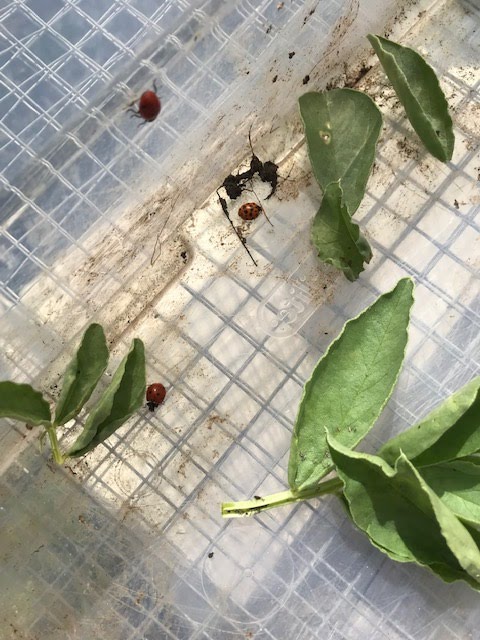
This week the Redwood Sustainable Agriculture class was able to get a week of good weather which allowed us to be able to spend class on the farm preparing for spring. The good weather brought out several ladybugs on to our bell beans and other plants that were having pest problems. Ladybugs are a beneficial companion on our garden and eat many smaller insects that are pests to our garden. They are attracted to aphid infested plants with moisture and our garden at the moment is a great area for them to stay. The main prey or food of the ladybug is aphids and their eggs. One lady bug can eat over 5000 aphids in their life time and be a great way to reduce these negative insects. Ladybugs also eat on scales, mealybugs and other parasitic pests like white flies that are known to negatively affect plants. Having ladybugs in your garden is a great way to reduce these pests without the use of pesticides, which is something we try and do on the farm. These little red bugs are one of the most beloved insects of gardeners and farmers who do not use pesticides and this is why we try to encourage and support them on our farm.
-Cole Rehm

New bed planting
Recently the SUSTAG students have had an real eventful week. With the new upcoming season they are finally implementing the plans of what new crops to plant. The days on the farm has been chalk full of digging, weeding, and watering. Spring is the perfect season to take full advantage of planting lettuce, squash, tomato, and onions. The perfect balance of sun and rain provide optimal conditions. In addition to spring planting, the sustag students had to study for a midterm this week as well. The content consisted of how we can improve our farm to better efficiency and sustainability. —Qian


Transplants
On the farm this week, we planted some seedlings donated by the Indian Valley Campus Farm. Some of us visited the Indian Valley Farm last week, and volunteered on the farm. My group, in particular, transplanted seedlings into pots, so it was cool to see some of the seedlings that we transplanted come to our farm. The Indian Valley Farm is a certified organic farm, just like ours. They grow all sorts of crops from olive trees, to strawberries, and lettuce. The fact that the IVC farm gave us their extra seedlings is very sustainable because it minimizes waste and boosts the crop diversity on our farrm. It is also good that we are trading with the ICV farm because it is ideal to form strong realtionships with other organic farmers, in order to exchange information with each other on how to make the most out of sustainale farming. The IVC farm gave us a variety of crops: mixed letucces, eggplant, cucumber, roma, and kale. My group planted some mixed letucces in our bed because it is a calorie crop and we needed to balance our calorie to carbon ratio in our bed. I think it's cool how an organic seedling can be raised in one enviroment, and then flourish in another enviroment.


Mak L.
Nick's summary
This last week in Sustainable Agriculture not all that much happened. This was because of the awkward scheduling from the standardized tests that underclassmen had to take this week, as well as the fact that we had to take our mid term on block day which kept us inside an extra day. The one day that we were able to get out onto the farm every groups job was to plant the new seedlings that came from IVC over the weekend. Planting all of these seedlings this week was very important because we need healthy pre-started plants in our soil beginning to grow over spring break. Our classes beds are all very wet and don't have the best soil, so trying to start plants in bed from seed is extremely hard. The seedlings are all different kinds of plant types and crop varieties which will benefit us a lot as the season goes along. Our markets will be full of a mix of good spring and summer crops that have hopefully grown in well. On the last day of the week we chose our books to start our reports on. Wishing everybody a good spring break and please do try and visit your bed once or twice this week!!
Subscribe to:
Posts (Atom)