Monday, May 21, 2018

The Unsettling of America


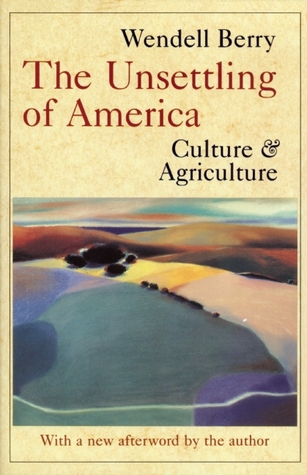
This week (week of may 7), we had a seminar in class about sustainability. This seminar was based on books that were read by students. Some of the problems discussed were about our culture of convenience. This gets in the way of sustainability because achieving it requires thought and care. For example, waste cannot be simply thrown away as we are all so used to doing, it must be composted and recycled to the extent that it can be in order for sustainability to be possible. As Mr Stewart pointed out, it is important to get people to enjoy practices that promote sustainability because that is what it takes in order to have a cultural shift away from convenience. I personally read the book the Unsettling of America by Wendell Berry. This book discusses the environmental, cultural and economic impacts of industrialized farming. These impacts include an increase in the psychological distance between Americans and the land in which their food is grown which leads to a loss in respect for the natural environment, the destruction of farming communities, and the reliance of farmers
 on federal subsidies. Image result for unsettling of america
Tommy

Iron Chef #4


This week was a special week for our class because we had our last Iron Chef competition. The theme of the competition was centered around fava beans. On Tuesday, we received a large donation of fava beans and spent the class period shucking them to prepare for Wednesday. On the day of Iron Chef, myself and others decided to saute the fava beans with kale, garlic, olive oil, salt and pepper. This is how we cooked the fava beans: In a large frying pan over medium heat we heated the olive oil. Then we added the fava beans to cook, stirring frequently, until the favas were tender, for about 3 minutes. We added salt and pepper to taste. Before sauteeing the fava beans, we had to boil a pot of water and let them cook a bit in order to cook the layer of shelling that protects the actual beans from the environment. Fava beans are one of the oldest domesticated food legumes. References to favas occur in both the Talmud and the Mishna, indicating they have been part of the Middle Eastern diet since at least since the 4th century.

We had a blast cooking this week and are all sad that this was our last Iron Chef!

Kenzie


Tuesday, May 8, 2018

More final project work


This week was the first week that we started our end of the year projects. The first day (Tuesday) was very chaotic because everyone was trying to finalize their projects with Mr. Stewart. The second day (Wednesday) was more independent. We all got started on out projects right away. There are many different projects going on at the same time. One group is making a new table for the hoop house, another group is making stools to sit on while working, another is making a mural, others are making new signs for the farm, and I think you get the point. We are trying to beautify and improve the farm as much as we can. My favorite project is adding new compost bins in the parking lots to collect more compost for the farm. I think that this is a very necessary item because there is too much food that goes to waste every day. So, although this week is crazy, it is really fun to work on thing that we believe can help the sust. ag. kids for years to come!
—Raya


Final Project Work


As we're approaching the end of the year, all sustainable agriculture students have been challenged with creating their own final project that incorporates some of the techniques we have learned throughout the year. The guidelines are loose and the purpose of this project is to take self-directed action and help improve the RHS farm. This week, both sustainable agriculture classes had time to create a detailed plan of their project and begin working. One student, Carson Gilley, has come up with the idea to create stools that can be used on the farm. He believes that having a place to sit while working, instead of kneeling, will allow people to be comfortable which will make students more productive. Another group is making compost bins that will be placed in the front lot of Redwood. Along with the bins, they are creating posters that clearly label which foods go in which bin. They plan on monitoring the bins at lunch on certain days and bringing the compost to the farm to use. Other groups are working on making the farm more visually pleasing. For example, one group is working to create a mural that would be placed on the front of the gate of the farm. Can't wait to see how all of the projects turn out!

Olivia Treadway


IVC Organic Farm


Every block Wednesday, Sophia and I head to IVC in Novato for our internship. We work on a lot of weeding in the beds that have overgrown weeds and we get to wear really cool straw hats so we're basically real farmers. A few weekends ago, we volunteered at their plant sale on Sunday and got to do a lot of hands on learning. We spent the day learning about the different kinds of plants being sold and restocking them and watering them. We planted and watered many seeds that will soon grow into taller plants to be sold. There was a huge range of plants such as chard, kale, tomatoes, basil, and native flowers. One herb that I really liked the taste of was the licorice mint, also known as Anise Hyssop. It's neither a licorice or a mint plant, but it tastes exactly like both. It's an herb that can be used for desserts or drinks! The rest of the day was spent weeding the strawberry beds with big red strawberries about to be harvested while a small band of people played the guitar and banjo. 


Tuesday, May 1, 2018

Market Gardener


On Monday, April 23, 2018 both Sustainable Agriculture classes watched Chapter 3 to Chapter 5 of The Market Gardener.

Chapter 3 demonstrated how Jean-Martin Fortier prepares his 30 inch wide by 100 foot long raised beds.  Fortier first removes the black tarp used to kill weeds and increase the rate of decomposition of left over waste from previously grown vegetables.  A walking tractor is used to minimize the CO2 emissions that is able to have many attachments to be of multiple use on their farm.  The soil is turned using an attachment for the tractor, aerated with a broad fork/u-bar, 5 or 6 wheelbarrows of vermicompost and local chicken manure, then another attachment is used to mix all amendments.

Chapter 4 mentions green manures and the importance of rhizobium that causes beneficial root nodules on crops.  First, this chapter of the movie explains to never leave soil bare and that cover crops should be planted a few weeks before the current crops are harvested so that they all mature by the time the crop is pulled.  Next, those cover crops are then chopped and left on top of the soil to create the green manure.

Chapter 5 is about how Fortier transplants his seedlings into the raised beds on his farm.  To plan where each seedling will be placed a rake is used to space each row in the bed by used rubber caps to create the rows when the rake is run along the length.  The same technique is used along the width of the bed to create a grid in the soil where the seedlings will be placed at the intersections.  His technique is to plant intensively but also keeping in mind that when the crop is 75% to full growth he wants to leaves to be touching to create a canopy that avoids the growth of weeds and maintain moisture in the soil. --CN


Spring Planting

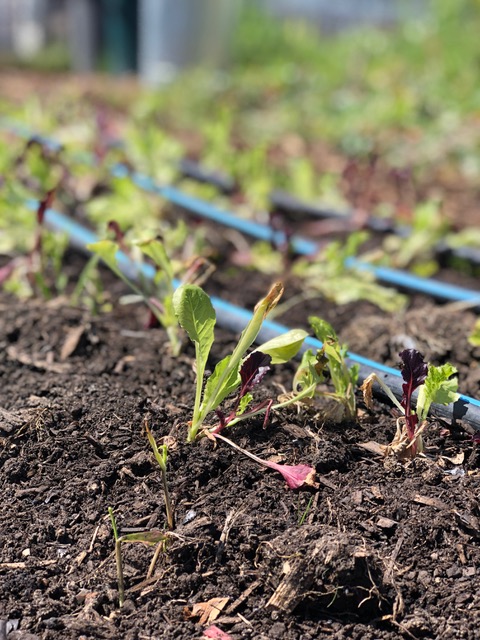
This week in sustag we planted different varieties of lettuce in the beds north of the hoop house. We started by removing large weeds and old crops from each bed. We then turned the soil with a shovel to slow further weed growth. Compost was added to improve the soil quality and fill in any larger holes left over from turning the soil. Next we raked the topsoil on each bed to make it smooth and put the irrigation lines back in place. To begin planting we used the six inch dibble board to mark the correct spacing for each plant. Finally it was time to plant, we used trowels to make each dibble hole larger and transplanted the lettuce starts into the holes. We dug each hole deep enough so there was ample room underground for the roots to avoid j rooting. Finally we thoroughly watered each newly planted lettuce start and checked the irrigation for any holes. We hope to harvest this lettuce in a couple of weeks and sell it back to the community during a market day.

—Dutch